
If thoughts are alive and if that which lives thinks, then perhaps the living world is enchanted. What I mean is that the world beyond the human is not a meaningless one made meaningful by humans. Rather, mean-ings—means-ends relations, strivings, purposes, telos, intentions, functions and significance—emerge in a world of living thoughts beyond the human in ways that are not fully exhausted by our all-too-human attempts to define and control these.
…If thoughts exist beyond the human, then we humans are not the only selves in this world. We, in short, are not the only kinds of we. Animism, the attribution of enchantment to these other-than-human loci, is more than a belief, an embodied practice, or a foil for our critiques of Western mechanistic representations of nature, although it is also all of these as well. We should not, then, just ask how some humans come to represent other beings or entities as animate; we also need to consider more broadly what is it about these that make them animate.
—Kohn (2013)
I’ve heard some theories about the function of Antlers in deer, mostly relating to mating, dominance and defense. Antlers are used for display of excess, a deer that can allow itself to carry it, is ranked high in terms of genetic fitness, has more chance to produce healthy offsprings. Antlers are also used in ritualized combat, it has a typical sequence – approach, posture, clash, retreat. Usually it establishes a hierarchy without causing harm, injury or death. Besides that it can be used for defense in certain situation.
During the change of seasons, the antlers shed annually, typically in late winter. Regrowth begins in spring and is among the fastest-growing tissues in mammals. The ‘velvet’ tissue causes irritation to the deer, so they use trees to shed them off, exposing the bone tissue below, hard surface antlers.
Speech : the antler of the mind
While hiking in northern Sweden, I had the chance to come across reindeer, which made me revisit my thoughts about deer and their antlers. Sometimes, there was no way to distinguish the antlers from the bushes and tree branches next to them. The deers and the trees form an organic perceptual unity, a symbiotic relation. For the deer the tree becomes a protector, making it hard for other animals else to distinguish between the deer and the tree. What does it mean for us people to reflect on that symbiosis, can it actually teach us something ? Can it tell a story ?
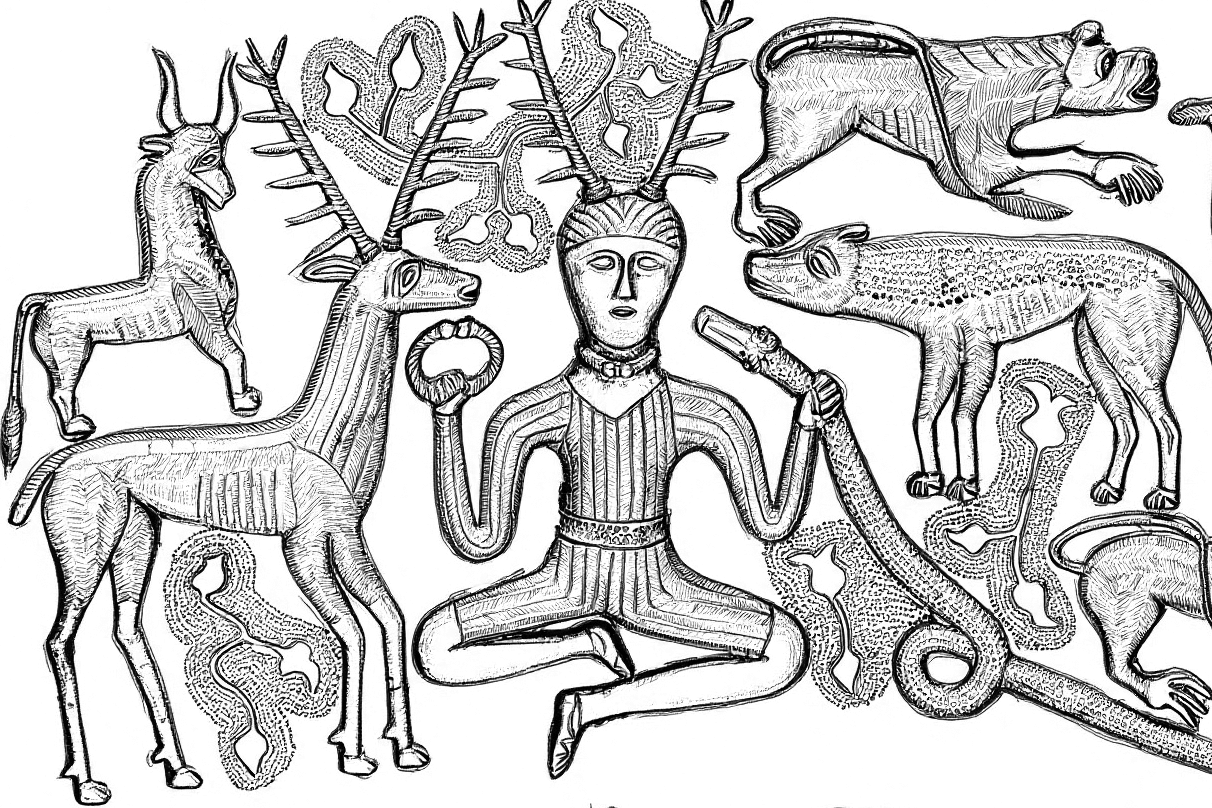
Above we see Gundestrup cauldron, plate A, 1 BCE. The main figure is identified as Cernunnos, a Celtic deity associated with wild nature, fertility, animals, and liminality. His antlers, modeled on a stag’s (to his left), assumes to symbolize a deep connection to the animal world, growth, and seasonal renewal. They also suggest a shapeshifting or boundary-crossing nature, he is neither fully human nor animal, embodying both. Animal and human, nature and culture are merged into one.
This image, based on an ancient artifact suggests a meditative state in which a liminal state is achieved. The cognitive boundaries which we draw between ourselves and nature begin to blur.
I would say this technique leads to de-objectification. Objectification happens through language, where the relation between language objects are limited. Languages are always used though a cultural practice. If our cultural practice revolves around the sciences then sentences usually needs to be valid through verification.